
August Browne
The Man Who Rewrote His Own Story

Short on time? Tap the player above to listen to me read this post while you’re on the go.
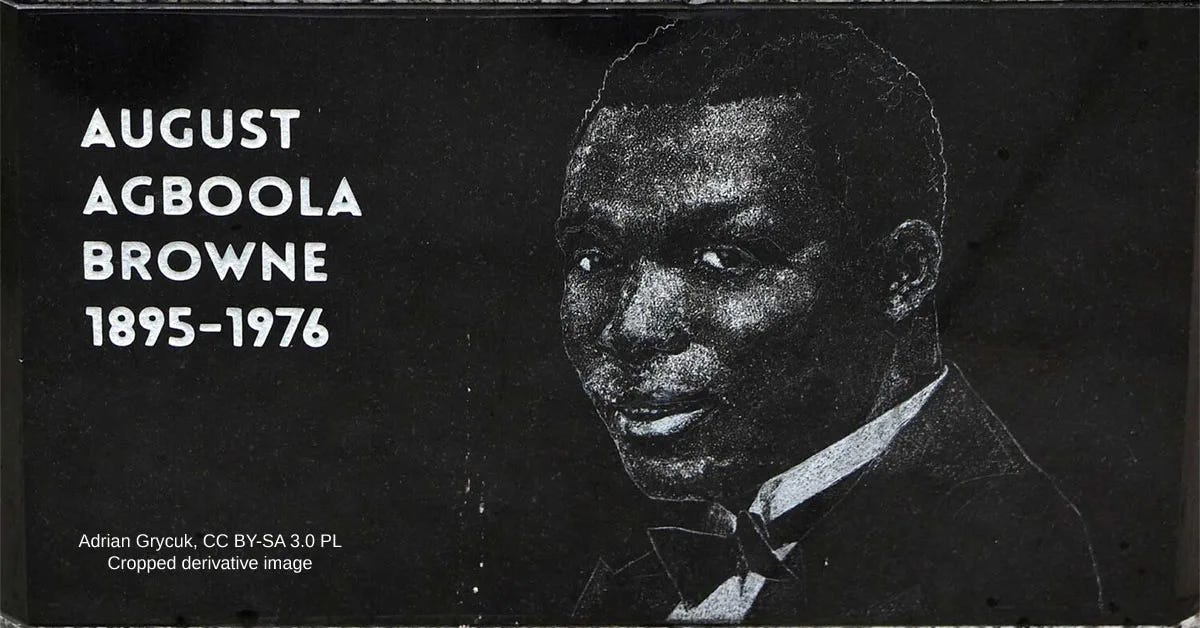
August Agboola Browne was long revered as the only Black fighter (alias Ali) in the 1944 Warsaw Uprising. Yet, recent archival evidence has surfaced, challenging this famous narrative and revealing contradictions that complicate his historic legacy.
Still, when you look past the myth, what stands out is even more interesting: the real life of a Nigerian-born jazz musician who found his place in interwar Warsaw, survived the Nazi occupation against all odds, and started over in London.
This is the story of a man who kept changing his life because he had to, to survive.
From Lagos to Warsaw’s Nightlife
August Browne was born in Lagos in 1895 and in 1922 came to the UK as a stowaway. The same year, he had reached Poland, first living in Gdańsk, then Kraków, and finally settling in Warsaw, where he became part of the city’s lively nightlife.
He worked as a jazz drummer and a fordanser (a professional dance partner for unescorted ladies) in top venues. He was well known in Warsaw’s most popular clubs like the bohemian Caveau Caucasien (the Caucasian Cellar). He even appeared in two films, including a 1936 comedy in which he had a cameo role of a musician who played the banjo.
August Browne is seen playing the banjo in the 1936 film Papa się żeni (Papa is getting married).
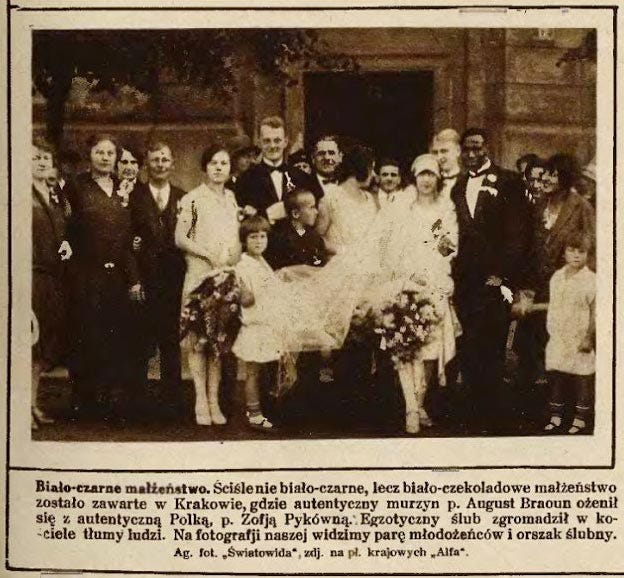
Browne married a Polish woman, Zofia Pykówna in 1927, and they had two sons. He was not just an outsider; he became part of the Polish community.
A Witness to High Society Drama
In 1933, Browne suddenly became known nationwide. A shooting at the Caveau Caucasien in Warsaw, caused by jealousy between a major and an engineer, led to a sensational trial. Browne, who was working on the dance floor that night, became a key witness.
Newspapers described his calm and clear testimony and the respect he earned during the military tribunal. This is one of the rare times we see him not as a performer, but as a trusted member of Warsaw’s society.
Surviving Occupied Warsaw
When the war began, Browne faced a difficult decision. As a British citizen, he could have left, but he chose to stay in Warsaw while his wife and sons escaped to the UK.
How a Black man survived six years in Nazi-occupied Poland is still one of the biggest mysteries of his life. His Kennkarte (German ID card), found in the UK National Archives, simply states that he has a “black complexion.” It is the only known ID document issued to a Black person from occupied Poland.
He survived by teaching languages, trading electronics, and using his resourcefulness.
But his own stories about the war later became inconsistent. Maybe he changed his story to meet the needs of post-war bureaucracy.
What we do know is that he was caught up in the mass evacuation of civilians after the Warsaw Uprising and ended up in the transit camps of Pruszków and Radomsko. The suffering he went through there caused lasting medical problems.
The Compensation Claim - and the Questions It Raised
Browne emigrated to Britain with his second wife in 1958. In the 1960s, he applied for compensation as a British victim of Nazi persecution. In his sworn statement, he said he had been imprisoned in Treblinka, but historians now believe this could not have happened.
“…there is no chance of an African having been detained there,” said Professor Jan Grabowski of the University of Ottawa, Canada, a world-renowned historian of the Holocaust and its aftermath, particularly in Poland. “We would have many, many testimonies about it.”
Even so, British doctors confirmed that he had serious, long-term injuries that matched what people suffered in camps and from malnutrition. His claim was approved, and he received £2,385, which would be about £59,000 today.
The truth probably lies somewhere between the official documents and the things left unsaid by a man who had been through more than he could want to describe.
A Quiet Ending in London
Browne lived a quiet life in London with his wife and London-born daughter. He went back to music, working as a session musician and teaching piano. His last years were simple, in declining health, and not well documented.
He died in London in 1976, aged 81.
His legacy is not the exaggerated wartime story once told in newspapers and documentaries. Instead, it is the story of a man who travelled across continents, moved through strict social worlds, survived the harshness of occupation, and kept changing his life to survive.
His life was shaped not by legend, but by resilience.
Source
Notes From Poland. 2025.
A Personal Note
In the early 1970s, I often visited the Ognisko Polskie (Polish Hearth) club in Kensington, where a group of Black musicians played on Friday evenings. I sometimes wonder if the quiet, disciplined drummer in that group was August Browne himself, a man who had been through so much, spending his last years in a familiar cultural setting.
If you remember those evenings or know anything about Browne’s musical life in London, I would appreciate hearing from you.
You can read my detailed post on the South Coast View website.